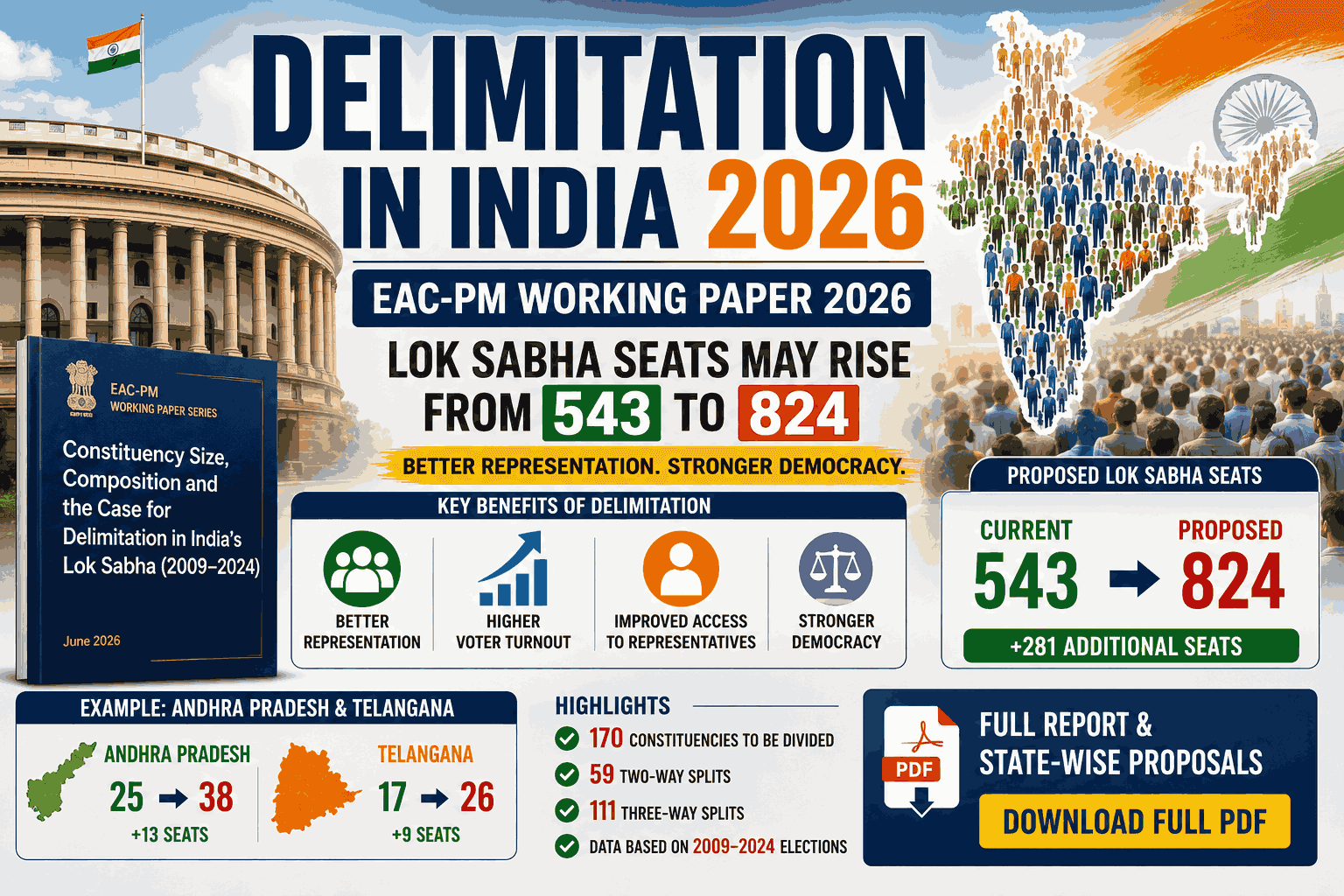
India is the world’s largest democracy, with more than 96 crore registered voters participating in elections. However, while India’s population has increased significantly over the decades, the number of elected Lok Sabha members has remained largely unchanged. This has resulted in many parliamentary constituencies becoming extremely large, with some Members of Parliament (MPs) representing more than 25 lakh voters.
To address this issue, the Economic Advisory Council to the Prime Minister (EAC-PM) released a research paper titled “Constituency Size, Composition and the Case for Delimitation in India’s Lok Sabha (2009–2024).” The study examines whether reducing the size of oversized constituencies and increasing parliamentary representation could improve voter participation and democratic representation.
According to the study, a targeted delimitation exercise could increase the number of Lok Sabha seats from 543 to 824, while also improving voter turnout and citizen access to elected representatives.
This article explains the concept of delimitation, the key findings of the EAC-PM Working Paper 2026, state-wise implications, benefits, concerns, and what these proposals could mean for India’s future electoral landscape.
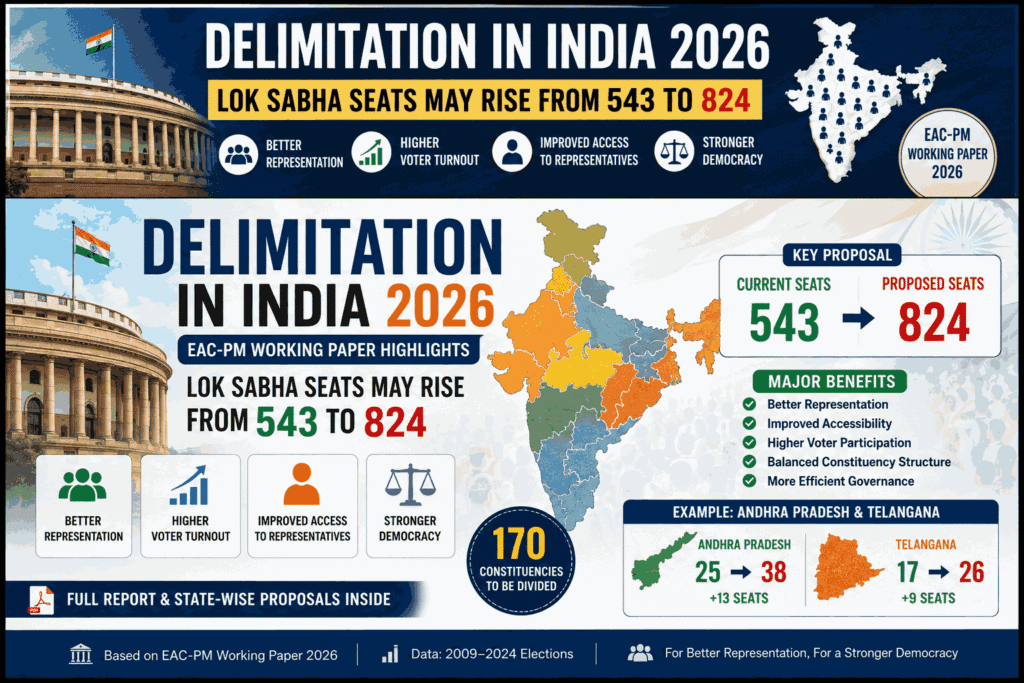
📄 Download Full Report: EAC-PM Delimitation Working Paper 2026 (PDF)
What is Delimitation?
Delimitation is the process of redrawing the boundaries of parliamentary and legislative assembly constituencies based on changes in population and voter distribution.
The primary objective of delimitation is to ensure that each elected representative serves a relatively similar number of citizens.
Example
| Constituency | Population |
|---|---|
| Constituency A | 10 Lakh |
| Constituency B | 30 Lakh |
If both constituencies elect one MP each, voters in Constituency B effectively receive less representation because one MP must serve a much larger population.
Delimitation aims to correct such imbalances and improve democratic fairness.
Why is Delimitation Important?
India’s population has grown rapidly since the last major delimitation exercise. As a result:
- Several constituencies have become excessively large.
- MPs represent significantly more voters than before.
- Citizens may find it harder to access their elected representatives.
- Regional representation imbalances have increased.
- Electoral administration becomes more complex.
The EAC-PM paper argues that constituency size is one of the factors that can influence voter participation and democratic engagement.
History of Delimitation in India
Delimitation is not a new concept in India.
Previous Delimitation Exercises
| Year | Purpose |
| 1952 | First Delimitation Commission |
| 1963 | Revision based on population changes |
| 1973 | Further constituency restructuring |
| 2002 | Delimitation Commission established |
| 2008 | Current constituency boundaries implemented |
The present Lok Sabha constituency boundaries are largely based on the delimitation exercise completed in 2008.
However, despite population growth, the total number of Lok Sabha seats has remained at 543.
This has led to renewed discussions about whether a fresh delimitation exercise is necessary.
Why is Delimitation Being Discussed Again?
The EAC-PM study highlights that many parliamentary constituencies now contain much larger electorates than they did in previous decades.
The paper examines election data from 2009, 2014, 2019 and 2024 to understand how constituency size affects voter turnout and political participation.
The researchers argue that extremely large constituencies may create challenges for both voters and elected representatives.
Key Highlights of the EAC-PM Working Paper 2026
| Particulars | Details |
| Current Lok Sabha Seats | 543 |
| Proposed Seats | 824 |
| Constituencies Considered for Division | 170 |
| Two-Way Splits | 59 |
| Three-Way Splits | 111 |
| Objective | Better Representation & Accessibility |
The study recommends a targeted approach rather than a nationwide uniform redistribution.
Proposed State-wise Lok Sabha Seat Expansion
According to the model discussed in the paper, several states could gain additional parliamentary representation.
| State / UT | Current Seats | Proposed Seats |
| Andhra Pradesh | 25 | 38 |
| Telangana | 17 | 26 |
| Uttar Pradesh | 80 | 120 |
| Bihar | 40 | 60 |
| Maharashtra | 48 | 72 |
| West Bengal | 42 | 63 |
| Gujarat | 26 | 39 |
| Rajasthan | 25 | 38 |
| Madhya Pradesh | 29 | 44 |
| Odisha | 21 | 32 |
| Assam | 14 | 21 |
| Jharkhand | 14 | 21 |
| Haryana | 10 | 15 |
| Chhattisgarh | 11 | 17 |
| Uttarakhand | 5 | 8 |
| Jammu & Kashmir | 5 | 8 |
| Himachal Pradesh | 4 | 6 |
| Chandigarh | 1 | 2 |
| Lakshadweep | 1 | 2 |
State-wise Proposed Two-Way and Three-Way Splits
| State | 2-Way Splits | 3-Way Splits |
| Andhra Pradesh | 1 | 6 |
| Uttar Pradesh | 6 | 17 |
| Bihar | 0 | 10 |
| Maharashtra | 0 | 12 |
| West Bengal | 1 | 10 |
| Gujarat | 1 | 6 |
| Rajasthan | 1 | 6 |
| Madhya Pradesh | 1 | 7 |
| Odisha | 1 | 5 |
| Assam | 1 | 3 |
| Jharkhand | 1 | 3 |
| Haryana | 1 | 2 |
| Uttarakhand | 1 | 1 |
| Jammu & Kashmir | 1 | 1 |
| Chandigarh | 1 | 0 |
| Lakshadweep | 1 | 0 |
Andhra Pradesh: A Major Beneficiary
The study suggests that Andhra Pradesh could gain substantial parliamentary representation.
Andhra Pradesh Highlights
| Particulars | Details |
| Current Seats | 25 |
| Proposed Seats | 38 |
| Additional Seats | 13 |
| Two-Way Splits | 1 |
| Three-Way Splits | 6 |
If implemented, these changes could significantly improve representation across the state.
Telangana: Significant Representation Growth
Telangana is another state expected to see notable changes.
| Particulars | Details |
| Current Seats | 17 |
| Proposed Seats | 26 |
| Additional Seats | 9 |
Key Constituencies Highlighted
- Hyderabad
- Secunderabad
These constituencies are among those identified for potential three-way division due to their large electorate size.
Potential Benefits of Delimitation
1. Better Representation
Smaller constituencies allow MPs to focus on fewer voters and local issues more effectively.
2. Improved Accessibility
Citizens may find it easier to interact with their elected representatives.
3. Stronger Democratic Participation
The study suggests that reducing constituency size could improve voter engagement.
4. Balanced Constituency Structure
Population disparities between constituencies could be reduced.
5. More Efficient Governance
Representatives may be able to respond more quickly to local concerns.
Could Voter Turnout Increase?
One of the most interesting findings of the study is the relationship between constituency size and voter turnout.
According to the analysis, smaller constituencies could encourage more voter participation.
Estimated Impact
| Factor | Estimate |
| Voter Turnout Increase | 0.3% – 2.3% |
| Additional Voters Participating | 9–23 Million |
The paper suggests that a targeted delimitation plan may help strengthen democratic participation.
Concerns and Challenges
While the proposal offers potential benefits, it also raises important questions.
Major Concerns
- Impact on federal balance between states.
- Changes in political representation.
- Administrative complexity.
- Requirement for constitutional and legal procedures.
- Need for consensus among stakeholders.
Delimitation remains one of the most debated electoral reform topics in India.
Important Clarification
The EAC-PM Working Paper is a research document.
What the Paper Does
✅ Provides research and analysis
✅ Suggests policy options
✅ Evaluates constituency size effects
✅ Recommends targeted seat expansion
What the Paper Does Not Do
❌ Change any law
❌ Increase Lok Sabha seats immediately
❌ Redraw constituency boundaries
❌ Automatically implement delimitation
Any future delimitation exercise would require constitutional, legislative and administrative action.
Frequently Asked Questions (FAQs)
What is delimitation?
Delimitation is the process of redrawing constituency boundaries to ensure fair representation based on population changes.
How many Lok Sabha seats currently exist?
The Lok Sabha currently has 543 elected seats.
How many seats are proposed in the EAC-PM model?
The study presents a model that could increase the number of Lok Sabha seats to 824.
Is delimitation being implemented immediately?
No. The working paper is only a research study and does not automatically change any law.
How many additional seats could Andhra Pradesh receive?
According to the study model, Andhra Pradesh could increase from 25 seats to 38 seats.
How many additional seats could Telangana receive?
Telangana could increase from 17 seats to 26 seats.
Why are some constituencies proposed for three-way splits?
The study identifies certain constituencies as exceptionally large in terms of electorate size and suggests dividing them into smaller units.
Will constituency boundaries change now?
No. Any actual changes would require approval through official constitutional and legislative processes.
About the Economic Advisory Council to the Prime Minister (EAC-PM)
The Economic Advisory Council to the Prime Minister (EAC-PM) is an independent advisory body that provides economic and policy-related recommendations to the Government of India. The council regularly publishes research papers and analytical studies on national issues.
The Delimitation Working Paper 2026 is one such research study intended to contribute to policy discussions on electoral representation and democratic participation.
Key Takeaways
The EAC-PM Delimitation Working Paper 2026 has reignited discussions on the future of parliamentary representation in India. By proposing a targeted increase in Lok Sabha seats and the division of oversized constituencies, the study argues that better representation, improved accessibility and higher voter participation may be possible.
However, the proposals remain recommendations and not government decisions. Whether India undertakes a future delimitation exercise will depend on constitutional, legal and policy decisions made by the appropriate authorities.
Disclaimer
This article is intended for informational and educational purposes only. The information is based on the EAC-PM Delimitation Working Paper 2026 and publicly available sources. The proposals discussed in the paper do not constitute an official decision of the Government of India. Readers are advised to refer to official government communications for future developments.
About the Author
Chindukuri Sivaramakrishna is the Founder and Editor of National Info Desk, an independent information platform dedicated to Government Jobs, Government Services, Government Schemes, Aadhaar Services, Certificates, and citizen-focused guides in India.
With a focus on accuracy, simplicity, and reliability, he publishes easy-to-understand content based on official notifications, government portals, and trusted public sources. His goal is to help citizens, students, job seekers, and beneficiaries access important government information without confusion.
Through National Info Desk, he strives to make government-related updates more accessible and understandable for everyone.
🔗 Learn more: https://nationalinfodesk.com/about-national-info-desk/
📧 Contact: contact@nationalinfodesk.com